

If the first half of 2026 proved anything, it’s that markets can absorb more bad news, and recover faster, than most of us expect. In late February, U.S. and Israeli strikes on Iran touched off a war, an energy shock, and a flood of grim forecasts. Oil spiked toward $120 a barrel, and the S&P 500 finished the first quarter down 4.4%. Then came the harder job: staying seated. A fragile ceasefire took hold in the spring, a framework to end the war was signed in mid-June, and markets delivered the best quarter in six years. The S&P 500 rose 15.2% in the second quarter, its largest quarterly gain since 2020, and closed the first half up 10.2%, near all-time highs. Investors who traded the headlines may have missed the rebound. Investors who remained disciplined stayed focused on their long-term goals.
Q2 by the Numbers (A Calm Look Back)
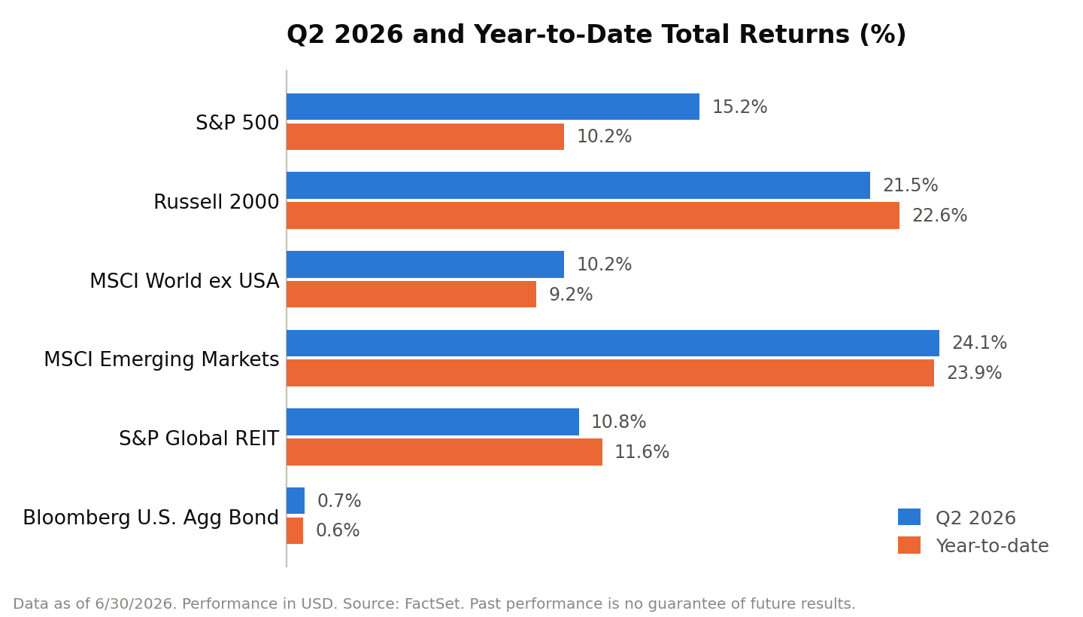
- S. Equities: The S&P 500 returned 15.2% for the quarter, its best showing in six years, lifting the index to 10.2% for the year. Small caps led the way: the Russell 2000 gained 21.5% and now tops the leaderboard year-to-date, up 22.6%.
- Non-U.S. Equities: Developed international markets rose 10.2% (MSCI World ex USA). Emerging markets stole the show, up 24.1% for the quarter and 23.9% year-to-date, helped by Asia’s central role in the global AI supply chain.
- Fixed Income: Bonds did their job, quietly. The Bloomberg U.S. Aggregate returned 0.7% for the quarter as the 10-year Treasury yield rose to 4.47%.
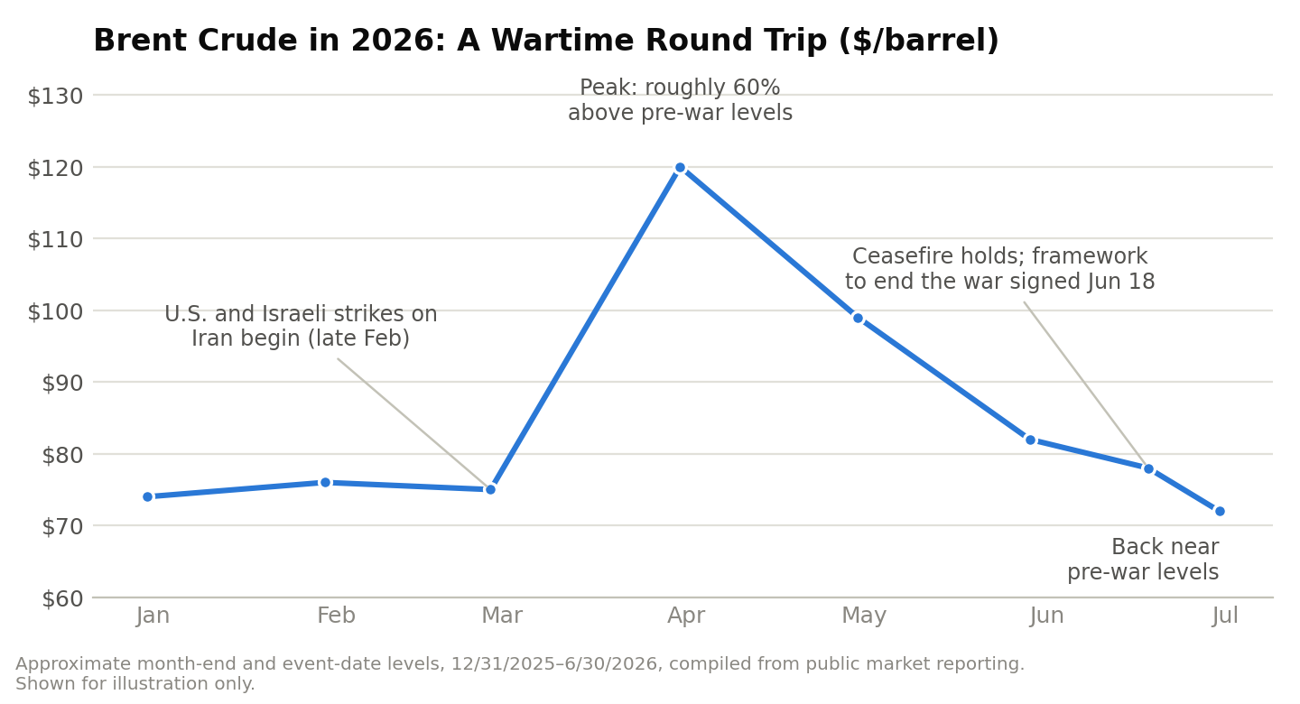
- Energy: Brent crude spiked roughly 60% after the war began, then gave nearly all of it back, finishing the quarter close to where it started the year (Figure 2).
Figure 1 | Q2 2026 vs. year-to-date total returns across major asset classes.
What We Think Actually Mattered
- Long-term investing helped face uncertainty. The best quarter in six years began within days of some of the scariest headlines. Nobody rang a bell at the April lows. Nobody ever does.
- Diversification continued to play its investing role. The first half was led by the very assets investors were most tempted to abandon after a decade of U.S. mega-cap dominance: emerging markets, small caps, and value stocks. The mega-cap “Magnificent Seven,” meanwhile, finished it in negative territory.
- Round trips are normal. Oil went from the mid-$70s to roughly $120 and back. Reacting at the top of that chart felt reasonable in the moment. It always does.
None of this required prediction. All of it required patience.
The AI Buildout: Big Numbers, Bigger Questions
The other engine under this market is capital spending on artificial intelligence, and the numbers have become difficult to overstate. The largest technology companies have signaled combined 2026 infrastructure budgets approaching $700 billion, up more than 70% from last year, and the effects are visible everywhere: the benchmark semiconductor index just posted the best quarter in its history, the technology sector rose nearly 32%, and demand is spilling into power, networking, memory, industrials, and cybersecurity.
What has changed is what the money is buying. The industry is moving from chatbots that answer questions toward “agents,” software that can take an objective, gather context, reason through the steps, act, and remember what it did, all running around the clock. Whatever one makes of that vision, building it requires extraordinary amounts of computing, memory, and electricity, which is why this investment cycle now reaches well beyond Silicon Valley. It also helps explain emerging markets’ surge: Taiwan and South Korea sit at the heart of the AI hardware supply chain.
Two cautions, offered calmly. First, the market is getting choosier about winners. Even in a record quarter for chipmakers, several of the largest AI spenders finished the half in negative territory amid worries about datacenter overspending and rising memory costs. Spending, it turns out, is not the same thing as earning. Second, concentration cuts both ways. We would rather own this theme the way we already do, which is broadly, globally, and with attention to valuation and profitability, than make concentrated bets on whichever company had the best week.
Iran, Oil, and an Uneasy Peace
The war with Iran was, first, a human tragedy. For markets, it was also a stress test, and the market’s verdict is worth studying (Figure 2). Brent crude jumped roughly 60% after the strikes began in late February as the Strait of Hormuz came under threat, impacting gasoline prices and headline inflation. Then diplomacy did its work: a tentative ceasefire in April, a signed framework to end the war in mid-June, and by quarter-end oil sat within a few dollars of its pre-war price. The energy sector, the first quarter’s standout, finished the second quarter as the market’s weakest, down more than 13%.
Figure 2 | Oil prices round-tripped as the conflict escalated and then wound down.
The shock still left a mark. Energy costs pushed headline CPI to 4.2% in May (core: 2.9%), and the Federal Reserve held rates steady while signaling little appetite to cut. New Chair Kevin Warsh presided over his first meeting in June, futures markets now lean toward rate hikes, not cuts, over the coming year, and the European Central Bank has already raised once. Against that backdrop, bonds still ground out a positive quarter.
An honest question: if we had told you in January that the U.S. would be at war in the Middle East by March, would you have predicted record highs by June? Neither would we. That is not an argument for ignoring geopolitics. We see it as an argument against trading on it.
A Brief Academic Aside (We’ll Keep It Short)
Emerging markets’ banner half looks less surprising with fifteen years of context. Avantis Investors recently compared market growth with fundamental growth across regions from 2010 to 2025. U.S. market capitalization grew 361%, far outpacing growth in U.S. book equity (110%) and earnings (192%). In other words, much of the U.S. advantage came from investors paying ever-higher multiples. Emerging markets were the mirror image: book equity grew 242% and earnings 175%, fundamental growth rivaling the U.S., while valuation multiples went essentially nowhere. Fundamentals grew; prices didn’t fully follow. Years like this one are what it looks like when that gap begins to close. We don’t own global markets because we know when that will happen. We own them because we don’t.
Looking Ahead to the Second Half
What we’re watching: whether the ceasefire resumes; whether inflation recedes as oil normalizes; whether Chair Warsh’s Fed follows through on its hawkish turn; and whether this year’s enormous AI investments begin to show up as durable earnings rather than just enthusiasm.
What we’re doing: rebalancing portfolios after outsized moves, trimming what has run and adding to what hasn’t, capturing tax losses where the first quarter offered them, and revisiting fixed income now that the 10-year Treasury yields roughly 4.5%. Not flashy. Not reactive.
We wrote in January that a new calendar year doesn’t eliminate uncertainty, it simply refreshes it. Mid-year, we’d extend the thought: neither does a ceasefire, and neither does a rally. But if the first half of 2026 reminded us of anything, it’s that uncertainty does not preclude progress. If anything in your life has changed (work, family, liquidity needs, charitable intentions), reach out. We’d welcome the conversation. As always, we’ll keep building globally diversified portfolios, grounded in evidence, designed to endure quarters like the first and participate in quarters like the second.
— LA Wealth
LA Wealth Advisors is a DBA of Axxcess Wealth Management, LLC a Registered Investment Advisor with the SEC. Advisory services are only offered to clients or prospective clients where Axxcess and its representatives are properly licensed or exempt from licensure.
This newsletter is for informational and educational purposes only and should not be construed as investment, legal, or tax advice. Please consult your financial, tax, or legal advisor regarding your individual circumstances.The charts and index data shown are presented for illustrative purposes only. Index performance does not represent the performance of any specific investment, and it is not possible to invest directly in an index. Past performance is no guarantee of future results. Market and economic conditions are subject to change without notice.
Sources include Bloomberg, FactSet, and Avantis Investors for the periods indicated. Opinions and estimates constitute judgment as of the date of this material and may change without notice. References to specific indices or securities, if any, are for illustrative purposes only and are not intended as recommendations to purchase or sell any security.Investments involve risk, including the possible loss of principal. Diversification does not ensure a profit or protect against loss in declining markets.
LA Wealth Advisors is a DBA of Axxcess Wealth Management, LLC a Registered Investment Advisor with the SEC. Advisory services are only offered to clients or prospective clients where Axxcess and its representatives are properly licensed or exempt from licensure.
All information has been obtained from sources believed to be reliable, but its accuracy is not guaranteed. There is no representation or warranty as to the current accuracy, reliability or completeness of, nor liability for, decisions based on such information, and it should not be relied on as such.
The information provided is for educational and informational purposes only and does not constitute investment advice and it should not be relied on as such. It should not be considered a solicitation to buy or an offer to sell a security. It does not take into account any investor’s particular investment objectives, strategies, tax status or investment horizon. You should consult your attorney or tax advisor.
The views expressed in this commentary are subject to change based on market and other conditions. These documents may contain certain statements that may be deemed forward‐looking statements. Please note that any such statements are not guarantees of any future performance and actual results or developments may differ materially from those projected. Any projections, market outlooks, or estimates are based upon certain assumptions and should not be construed as indicative of actual events that will occur.

